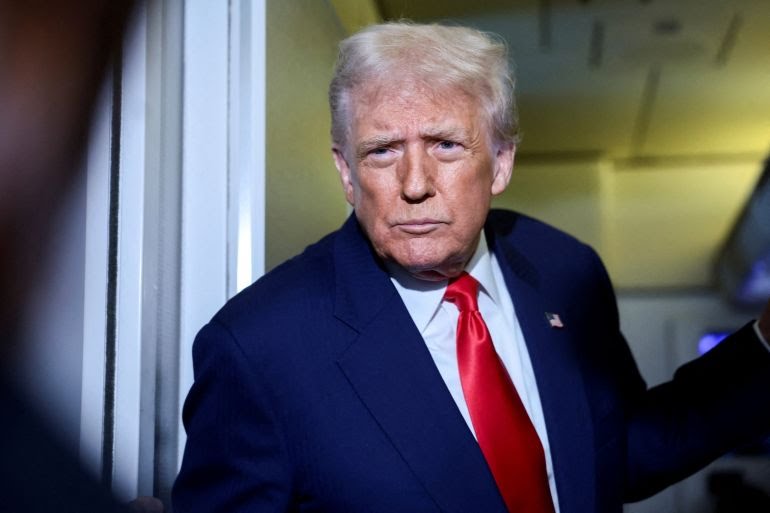
Based on ambiguous allegations that Christians in Nigeria are being “slaughtered” by Muslims, US President Donald Trump has declared that Nigeria would be added to a watchlist for religious freedom.
Trump clarified that the African country would be added to a Department of State list of “Countries of Particular Concern” in a social media tweet on Friday.
“In Nigeria, Christianity faces an existential threat,” Trump tweeted. The death toll among Christians exceeds thousands. The perpetrators of this horrific murder are radical Islamists. Nigeria is now a “COUNTRY OF PARTICULAR CONCERN,” according to my declaration.
Such claims have previously been refuted by the Nigerian government. However, detractors caution that calling Nigeria a “country of particular concern” may open the door to more penalties.
Additionally, it seems like Trump has circumvented the standard protocol for these kinds of issues.
The “country of particular concern” category was established by the 1998 International Religious Freedom Act to monitor and promote the abolition of religious persecution.
However, the US Commission on International Religious Freedom, a bipartisan organization founded by Congress, and State Department experts often recommend that designation.
Trump clarified in Friday’s statement that he had requested that the House Appropriations Committee and two members of Congress, Tom Cole and Riley Moore, “immediately look into this matter.” They’re both Republican.
Trump’s assertions seem to follow the rhetoric of right-wing lawmakers, who portray Nigeria’s contentious and occasionally violent conflicts as an instance of radical Islamists targeting Christians.
However, experts have described that framing as essentially false, pointing out that religious differences alone cannot account for the nation’s turmoil.
Nigeria is split between a predominantly Christian south and a predominantly Muslim north. For almost ten years, the nation has been plagued by Boko Haram’s terrorist attacks, which have caused unrest and displacement.
Tensions between mostly Christian farmers and mostly Muslim herders have also been heightened by disputes over resources like water, which have occasionally resulted in violent altercations. However, Nigeria has denied that religious affiliation is the main cause of these conflicts.
Nevertheless, in a statement following Friday’s news, Representative Moore repeated Trump’s assessment.
Moore stated, “I have been advocating for this designation since my first floor speech in April, where I highlighted the plight of Christians in countries with a majority of Muslims.”
“I intend to make sure that Nigeria gets the international attention, pressure, and accountability it urgently needs,” he continued.
Another Republican, Texas Senator Ted Cruz, also praised Trump’s choice. He stated in a press release, “I am deeply gratified to President Trump for making this determination.” “I have spent years fighting against the persecution and killing of Christians in Nigeria.”
Trump has worked to strengthen his base within the US Christian right since taking office for a second term in January.
He declared during a prayer breakfast in February that his administration will form a task force to eliminate anti-Christian prejudice inside the federal government.
His administration later published a memo in July permitting federal employees to preach at work.
In Friday’s message, Trump condemned suspected anti-Christian violence, but his administration has recently been under fire for its treatment of refugees, or those who are escaping persecution or violence back home.
Trump said on Wednesday that the number of refugees admitted to the United States would be capped at just 7,500 for the entire fiscal year 2026.
He clarified that the majority of those positions would “primarily be allocated among Afrikaners from South Africa” and “other victims of illegal or unjust discrimination” in a notice uploaded to the Federal Register’s website.
The fact that refugee status is granted out of fear of systematic persecution rather than discrimination was quickly brought up by critics.
Nevertheless, Trump has persisted in escalating diplomatic relations with South Africa by erroneously asserting that white Afrikaners are being subjected to a “genocide,” a concept that is often promoted by far-right figures.